A campaign for the price of dinner
Is $366 million a lot to spend on election campaigns? A comparison with a typical family's wealth shows how small that sum is for Elon Musk.
Elon Musk’s financial support for Republicans in the 2026 US midterm elections so far has been put at around $366 million.1 That sounds like a lot of money. But is it, if you have a trillion dollars — a million million?2 That is roughly how much Elon Musk is worth, although much of his wealth is tied up in company stakes.
You might think $366 million could buy quite a lot of influence during an election campaign. But does it at least come at a steep price? A really, really steep price? So the question is:
Sums like these are so hard to imagine that we need to put them in perspective. What percentage of his wealth did Elon Musk have to spend on these donations?
366,000,000 ÷ 1,000,000,000,000 × 100 = 0.0366%.
0.0366% is roughly one-thirtieth of one percent, so not very much. In fact, it is very little — probably so little that you would barely give it a thought. But that still does not make it particularly easy to grasp.
0.0366% — what does that mean for a typical US family?
To make it more tangible: what would the equivalent amount be for a typical American family? For this comparison, we use the median as our measure of a typical family’s wealth.3 The Federal Reserve, the US central bank, puts median net worth4 in 2025 at $215,900.5
Here is how we calculate what the same proportion would mean for a family with that net worth:
366,000,000 ÷ 1,000,000,000,000 × 215,900 ≈ $79.02.
The result is surprisingly small: $366 million for Elon Musk is equivalent to $79 for a family with median wealth. That $79 would buy roughly a fast-food dinner for four.
What now?
One person can support political campaigns with hundreds of millions of dollars while spending only a tiny fraction of his wealth. So little that he does probably not even notice it. Whether that is healthy for a democracy is not something we will discuss here. Others are doing that.
A family in the middle of the wealth distribution would have to come up with many times its entire net worth to contribute the same dollar amount. You could see this as an extreme imbalance in people’s ability to fund politics. Of course, we cannot measure here how much such spending actually influences elections or political decisions.
The reported sum is not a single transfer to a political party. Some of the funding flows through Political Action Committees, or PACs. According to the Federal Election Commission (FEC), so-called Super PACs may accept contributions of unlimited size.6 The independent election spending they fund must not be coordinated with candidates, their campaigns or political parties.7 The Democratic Party also receives hundreds of millions of dollars in donations.8
That leaves us with a final question:
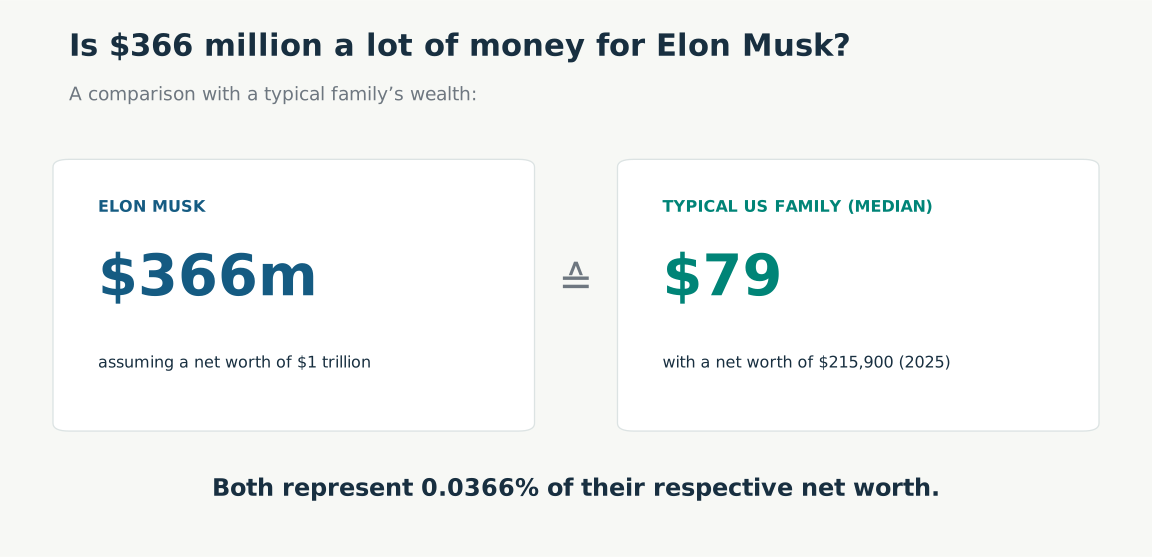
AI was used to assist with research, translate from German to English, and the creation of the chart.
Calculation details
Sources checked on 23 October 2026. The donation total comes from the Reuters report of 12 October 2026 and covers the election cycle beginning on 1 January 2025. For Musk’s wealth, we use a Forbes estimate from 9 October 2026, rounded to $1 trillion. Using the reported figure of $1.012 trillion would put the equivalent amount at around $78.
The comparison uses net worth: assets minus debts. The unit used in the Survey of Consumer Finances (SCF) is an economic family unit, which includes single people. It does not correspond exactly to a statistical household. The median is not divided by the number of people in the family.9
The family figure comes from the 2025 SCF, published on 9 October 2026. It has neither been projected forward to 2026 nor adjusted to 2026 prices. This is an illustrative comparison of figures from different points in time. The calculation gives $79.0194; in the text and chart, we round this to $79. For families with zero or negative net worth, a positive percentage of wealth is not a useful measure of financial burden.
The spending total is taken from the Reuters report and has not been reconstructed here from individual FEC filings. The wealth comparison alone establishes neither political control nor the ability to buy an election victory.
Sources
-
Reuters via Investing.com: Musk’s support for Republicans in the 2025–2026 election cycle, 12 October 2026 ↩investing.com
-
Forbes: Musk’s net worth, 9 October 2026 ↩tollbit.forbes.com
-
Wikipedia: Median (in German) ↩de.wikipedia.org
-
A home, retirement savings and company stakes differ in how easily they can be turned into cash. Our comparison initially shows only the proportion of net worth. ↩
-
Federal Reserve: Results of the 2025 Survey of Consumer Finances, 9 October 2026 ↩federalreserve.gov
-
FEC: Political Action Committees (PACs) and Super PACs ↩fec.gov
-
FEC: Contributions to Democratic Party committees, Section II of the statistics for January 2025 to June 2026, 1 October 2026 ↩fec.gov
-
Federal Reserve: Definition of the SCF family unit, methodological appendix to the 2014 report ↩federalreserve.gov